Valitse kieli:
Select Language:
Välj språket:


1.1 Car Controls

A Headlights*, indicator (turn signal)
* In an engine operated vehicle it is obligatory to use driving lights, attention lights or LED daytime lights during driving.
B Windscreen wiper and washer
C Parking brake
1 Mirror adjust
2 Clutch
3 Brake
4 Accelerator
5 Steering wheel
6 Horn
7 Ignition switch
8 Temperature control
9 Fan speed control
10 Air recirculation
11 Air flow control
12 Gear lever

The most important warning lights, that usually require immediate action, are bright red; other lights giving important information are often orange.
13 Speedometer
14 Tachometer
 General function error
 Fog light (front)
 Fog light (rear)
 High beam headlights
 Lights on
 Indicator
 Low fuel
 Airbag warning
 Front passenger airbag off
 Seat belt not on
 Low battery
 Power steering warning
 Engine oil pressure low
 Engine/ignition warning
 Cooling liquid over heated
 Indicator
 Braking liquid low / Parking brake on
 Brake pads worn out
 ABS warning
 EPS warning
 Door or hatch open
Using the Controls
Steering Wheel
Correctly adjusted steering wheel height and depth make effective steering possible in all conditions. Basic grip from a steering wheel is hands at 10 o'clock and 2 o'clock. Steering to right starts with left hand and steering to left with right hand. The hand turning the wheel lets go of the wheel at 8 or 4 o'clock and the other hand starts turning from 12 o'clock. Steering can be locked by taking off the ignition key and turning the steering until it locks. Steering lock opens when you turn the ignition key and steering wheel at the same time.

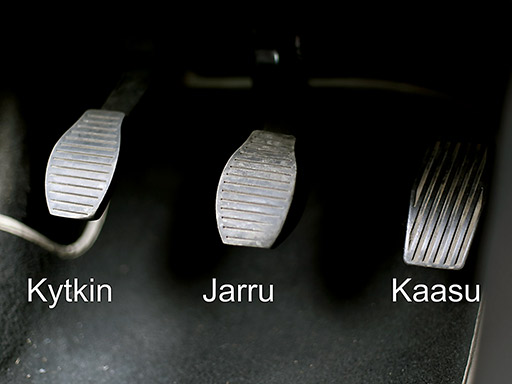
Pedals
Clutch pedal: The clutch connects and disconnects the connection with the engine and the wheels. The Clutch is used with left leg. Lift the clutch pedal slowly and the RPM (rotations per minute) drops a bit, you have reached the clutch feeling. By lifting the clutch more, the engine power connects to the wheels and the car starts to move. By pushing the clutch down, the engine power no longer connects to the wheels and you can stop the car while the engine is still running. The clutch has to be pushed down when changing a gear. If you reduce the speed, without changing a gear, you don't need to use the clutch. When the clutch is not used, the left foot rests on its place on the left side of the clutch pedal.
Brake pedal: The brake pedal is used with the right foot. Smooth stopping can be achieved by lightening braking power just before coming to a stop.
Accelerator: Without throttle the RMP of an engine is 400-700 rotations per minute. Before starting to move add basic throttle (circa 1500 rpm), so that you get more power for the start. When slowing down, utilize the engine brake by lifting the throttle.
Gears
In a car with manual transmission the driver chooses the gear-ration. Usually cars have 4-6 forward gears. The clutch has to be pushed down when changing a gear.

Estimated speed zones for different gears:
1st gear 0-20km/h nopeus
2nd gear 20-40km/h nopeus
3rd gear 40-60km/h nopeus
4th gear 60-80km/h nopeus
5th gear when speeds exceed 80km/h
New cars have an on-board computer that suggests the suitable gear for every driving situation..

Markings in automatic transmission:
N = Neutral
R = Reverse
D = Drive
P = Park
Parking brake
Use of the parking brake ensures that the car won't move by itself when parked. Parking brakes can be used when starting the car on a steep incline.
