Valitse kieli:
Select Language:
Välj språket:


2.2 Car safety
Active and passive safety
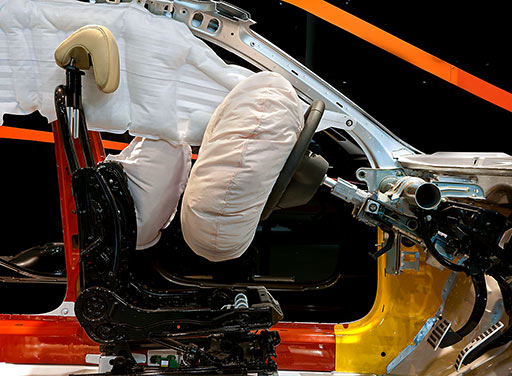
Road safety of a car can be divided to active and passive safety. Active safety prevents the car from getting into accident, when passive safety protects the passenger in an accident. In addition, passive safety also includes the risk for pedestrian in an accident.
Active safety
Cars should be equipped with at least the following:
Anti-lock braking system
Anti-lock braking system (ABS) allows the wheels on a motor vehicle to maintain tractive contact with the road surface while braking. ABS prevents the wheels from locking up and helps to avoid uncontrolled skidding. If the wheel locks up it cannot steer because all the traction is used to slowing the vehicle down. It is necessary to be able to transmit sideways forces through the wheels to make steering possible.
Traction control system
Traction control system is designed to prevent loss of traction. When the traction control system determines that one wheel is spinning more quickly than the others, it automatically activates the brake and/or reduces the engine power to that wheel to reduce its speed and lessen wheel slip.
Adaptive cruise control
Adaptive cruise control system takes over the throttle of the car to maintain a steady speed as set by the driver, just like normal cruise control, but it also uses a radar or laser to detect a slower moving vehicle in front of the car. System reduces the speed by lifting the throttle or by braking depending on the situation. The driver can determine the distance to a vehicle in front, which the system will maintain by adjusting the speed according to the vehicle in front. When the road clears up, adaptive cruise control will return to original driving speed.
Electronic Stability Control
Electronic Stability Control is a system that corrects steering errors made by the driver. Typical steering errors include too high situational speed, over- or understeering or car swerving. If Electronic Stability Control detects loss of steering control, it automatically applies the brakes and/or controls the engine power to help steer the vehicle where the driver intends to go. Braking is automatically applied to wheels individually.
The system is usually connected to anti-lock braking and traction control systems. The system monitors the conditions with speed sensor, steering sensor and acceleration sensors. For example, if in a left curve the rear starts to skid to the right the system brakes the right front wheel to counter.
Passive safety
Cars should be equipped with at least the following:
Safety belt
Car seats are equipped with safety belts. Correctly fasten safety belt secures the occupant of a vehicle against harmful movement that may result during a collision or a sudden stop. In a collision safety belt flexes and the forces are divided evenly to the strongest body parts. When a car crashes three type of impacts occur: first the car, then the person and finally the intestines of the person crash.
According to studies use of safety belt reduces deaths to half and injuries are smaller or fully prevented. Safety belt is at its best in a head-on collision and when the car rollover. Safety belt improves safety also in side impact and rear-end collisions.
Locking retractor
Often new cars have safety belt locking retractors. In a sudden braking or collision event it tightens the safety belt. This restrains the occupant in position and reduces the risk of hitting the steering wheel. It also keeps occupants positioned correctly for maximum effectiveness of the airbag.
Airbag
Purpose of an airbag is to cushion occupants during a crash and provide protection to their bodies. In a head-on collision airbag inflates in fraction of a second. The driver airbag is in the steering wheel and front passenger airbag in the dashboard. For side impact collisions side airbags are used. Front airbags in front of the driver and front passenger do not replace safety belts, but only complement the protection of safety belts.
Head restraint
Correctly adjusted head restraint is essential in preventing neck injuries. The restraint has to be at the same height as the head and as close to the head as possible.

Carriage of passengers
1. The maximum number of people in a vehicle at any one time, in addition to the driver, is specified on the vehicle registration document.
2. Driver and passengers have to use safety belts attached to the seats in: *
a) passenger car
b) bus
c) van
d) truck
e) three or four wheeler with chassis and light four-wheeler with chassis.
* The obligation to use a safety belt or safety device doesn’t concern a person who has a serious medical reason that prevents the use of such a device. The medical certificate stating this should be kept with in the vehicle and it must be presented to a police officer if he or she asks for it.

3. Children under 135 cm must use type approved child safety equipment made for correct weight class.
4. It is prohibited to carry children under 3 years old in a car without safety equipment.
The obligation to use a safety belt or safety device doesn’t concern:
a) a person who has a serious medical reason that prevents the use of safety belt,
b) henkilöä, joka ei voi käyttää turvavyötä sen vuoksi, että autossa on useampia matkustajia kuin siihen asennettuja turvavöitä.
5. Casually it is allowed to carry a child older than 3 years old in the back seat with safety belt on for a short distance, even if there is no safety seat.
6. Rear-facing child seats must not be used in a seat protected by a frontal airbag unless the airbag has been deactivated or the vehicle has an effective automatic airbag deactivation system.