Valitse kieli:
Select Language:
Välj språket:


7.2 Driving in traffic flow
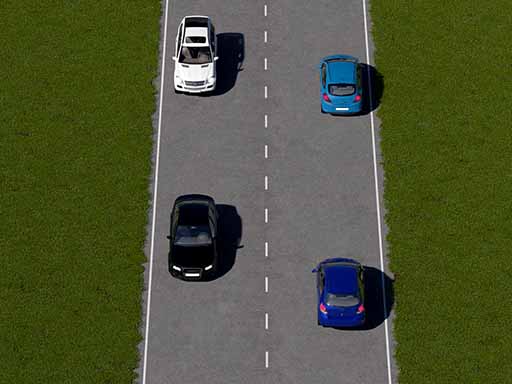
"Vehicles must keep as close to the right-hand side edge of the roadway as it is possible without endangering safety. However, the conditions and other traffic has to be taken into account."
When we drive on the right edge of the roadway we have minimum risk to collide with oncoming traffic. The driver has to give enough space to road users, like pedestrians, cyclists and moped riders, using the right-hand side edge of the road.

"When there are two or more lanes in the direction of travel, the driver must use the free lane furthest to the right and drive in the middle of the roadway without unnecessarily changing the lane."
When driving in the middle of the roadway you have sufficient space around you. Weaving through the traffic flow by constantly switching lanes disturb or even endanger other traffic. If there are two or more lanes in the direction of travel normally use the lane furthest to the right.
Cycle lanes

One-way cycle lanes can be separated from a roadway by road markings. Cycle lane may be used by cyclists. On cycle lane the cyclists must obey the same rules as when driving on the right edge of the roadway. Cycle lane can be used by all vehicles for turning from an intersection.

Bus lane sign indicates that the lane is for buses only. This lane can also be used by trams, emergency vehicles, police vehicles on duty and other vehicles that are shown in additional sign. When the bus lane is the furthest lane on the right it can be also used by mopeds and bicycles. The distance to which the sign applies extends until the next intersection, unless otherwise determined.

If the bus or tramway lane is also reserved for taxis the sign has a word "TAXI" at the bottom edge.

Tram lane can be used by emergency vehicles, police vehicles in duty and other vehicles shown in additional sign. Tram lane cannot be used for turning in intersection.
If there is a tram track on the roadway, but the lane is not marked as a tram lane, it is allowed to for other traffic to use the lane.

Driver must give way to buses pulling out from bus stops if the speed limit is 60 km/h or less. Buses pulling out from stops must use their indicators. Driver has to reduce the speed and if necessary stop to give the bus free exit from the bus stop.
How to change lanes
Driver is allowed to change the lane or otherwise move sideways only if it can be done without danger and without unnecessarily blocking other traffic.
Order of actions

Adjust your speed according to traffic rhythm.

Check from the rear-view mirror, that there are no faster vehicles, like emergency vehicles, etc., approaching from the behind.

Put on the left indicator.
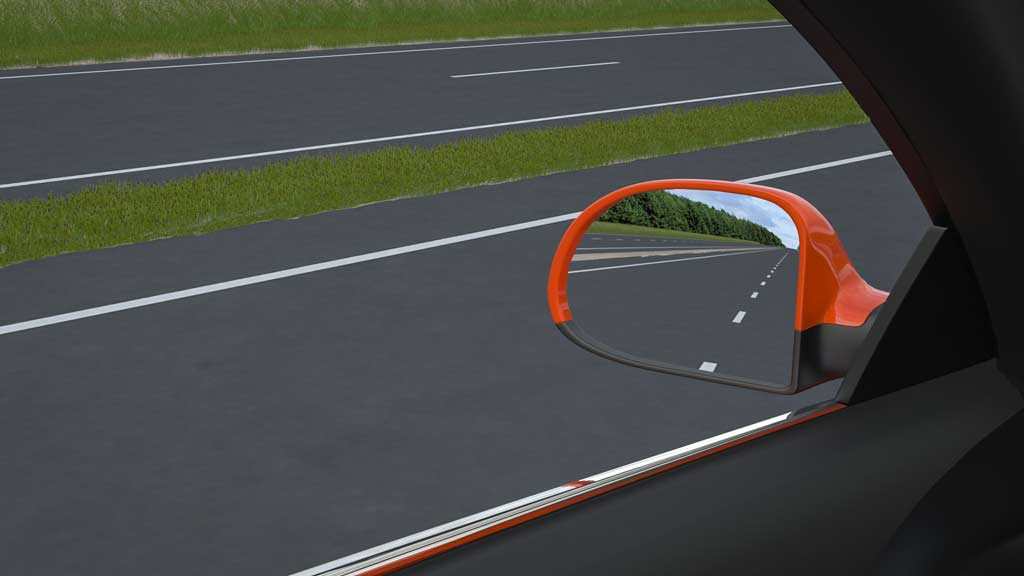
Check the side mirror and blind spot.

Look far ahead and change the lane.
Driving speed

Driver has to be especially cautious when approaching an intersection.
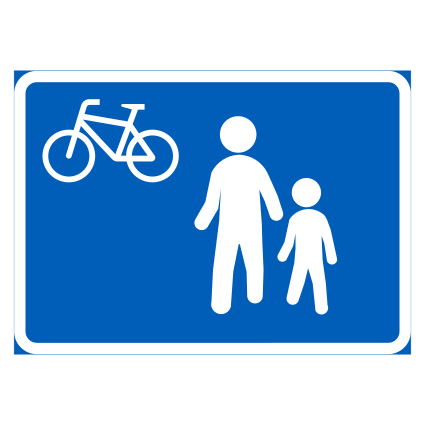
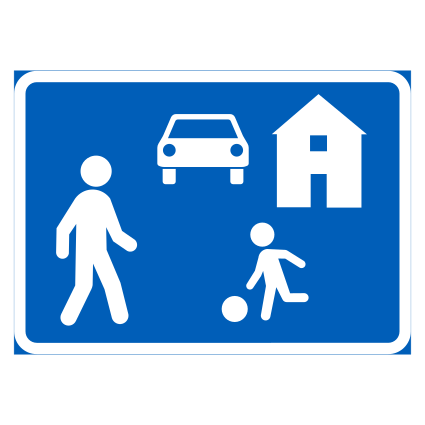
It is allowed to drive a motor vehicle on a residential street and foot-path only to park or to reach a real estate on the side of the street.
Other vehicles than bicycle, moped and a vehicle with a disabled parking permit are allowed to park only in a marked parking space.
Driving speed must be adjusted to walking pace and may not exceed 20 km/h. Pedestrians must be given free passage.

Speed limit in urban areas is 50 km/h.

Speed limit zone
Keeping a safe distance and obligation to exercise due care

When you are driving a vehicle, you must maintain a safe distance from pedestrians, cyclists and any animals accompanying them. If you are cycling, you must maintain a safe distance from pedestrians.
Special care must be exercised when approaching any of the following with a vehicle: a vehicle taking children to school or a kindergarten, a bus, tram or a child, an elderly person, a disabled person or anyone else who has obvious difficulty acting safely in traffic.