Valitse kieli:
Select Language:
Välj språket:


6.1 Observation and estimation
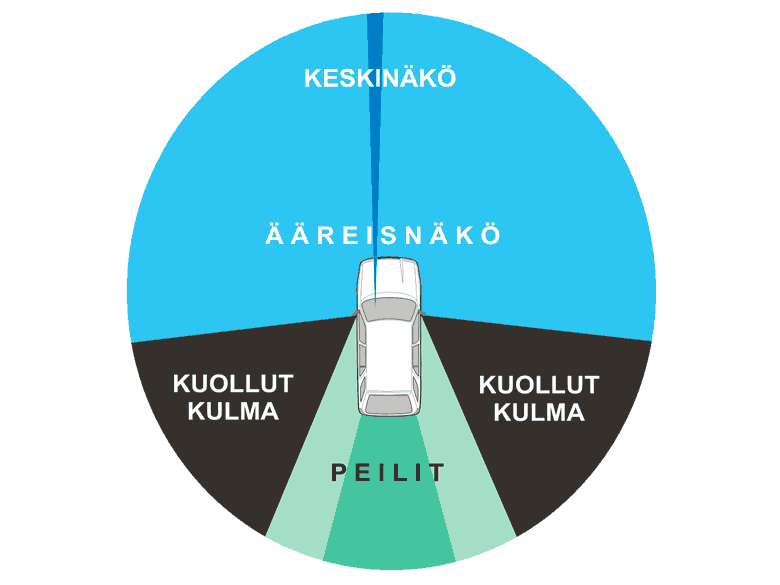
Close to all traffic information is transmitted through sight. Effective observing requires adequate eyesight. The goal is effective 360° observing. Field of view consists of the central vision and the peripheral vision.
Central vision is very narrow (circa 3°). It is used for all precise observations. While driving it determines the direction of the vehicle. Hands steer towards the point determined by the central vision.
Peripheral vision is wide. When standing still it is circa 200°. We cannot make precise observations with it. Peripheral vision is good at detecting motion and bright colors. While driving it measures distances to the sides. When speed increases the peripheral vision becomes narrower. The higher the speed the harder it becomes to observe effectively.
To achieve 360° observing, we have to monitor also the dead spots and mirrors. An experienced driver looks far ahead and uses quick glances to checks up things outside of the driving direction.
Estimation
Reliable estimation of speeds and distances is difficult for a person. Often a person underestimates speeds and overestimates distances.